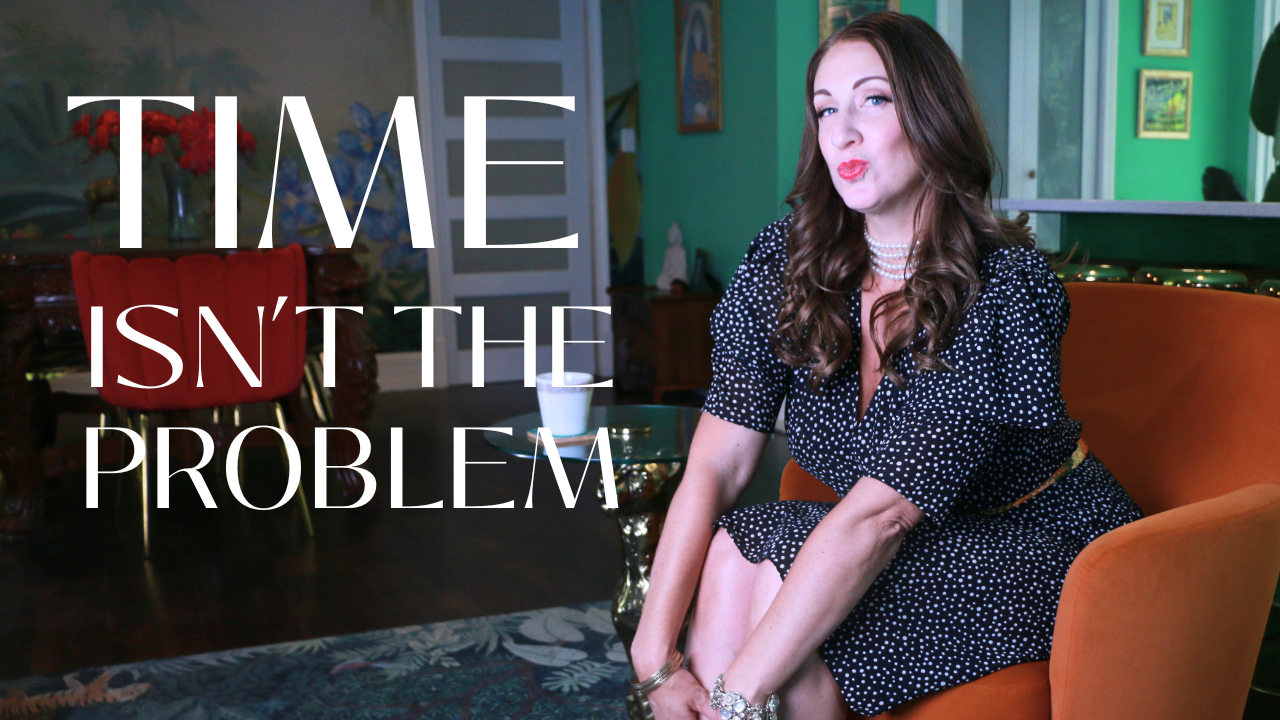
Hey there, Creative Souls. Welcome back to the Creative Spotlight. Today's post is hopefully short and sweet - as it should be because it's about time.
You may have heard of this concept before. Today I want to talk about Parkinson's Law as it relates to your creative process. Parkinson's Law is the observation that work expands to fill the time available for its completion. This means however much time we allot for a project, we'll use it. The project itself might expand in complexity (or destruction, or complication) simply because we gave it time to. So, as per usual, I would like to tell a story that exemplifies this lesson and then help you assimilate it into your own creative process and world.
If you've been reading this blog, then you know some of the creation stories of some of the shows that we've produced in our immersive theater. For instance, one of those shows which I talked about is called I Haunt You. It really, truly, from concept to curtain, took 10 years. It took so long. Now, that doesn't mean 10 active years working 40 hours a week all the time. It means 10 years because it was on the back burner a lot of the time; but it was on the back burner because I never really gave it a due date. I never gave the show a deadline, so it just kind of went on forever and ever and ever until I finally gave it a due date and the show came to be.
The next show we produced right after we produced I Haunt You was called Silence in the Jungle. There's another great lesson from that story that you can check out as well. That show took 3 months to produce. Wow, vastly different! 10 years versus 3 months. The shows are about the same length, full length 2-hour shows with an intermission. They are both equally complex, have a beautiful full-length soundscape, tons of costumes, all the bells and whistles, all the things that we do when we produce a Melonlight show. So why did one take 10 years and one took 3 months?
I'll tell you why: because that 10-year show, like I said, never had a timeline on it. What happened with the 3-month one? I was racing the clock… the biological clock. I was pregnant, and I had to hurry up and produce a show that I could perform while pregnant, but had to play the show for long enough to make some money on it before I had to get off stage because I was too pregnant and it was time to have a baby. I had a very tangible, real-world deadline on that show, and the deadline meant a lot. We produced the show in 3 months, and it was every bit as beautiful, impactful, and enjoyable for our audiences as was I Haunt You, which took a really, really long time to produce. That was such a great lesson with that show, having that very tangible deadline, because baby says it has to be done by certain date. I couldn't wrestle with that timeline. It had to be done.
I'm NOT suggesting that you get pregnant all the time to have very real-world deadlines on your creative work, but it was such a great lesson to be like, "Holy crap, I didn't know we could produce this level and quality of work in such a short timeline." Turns out, we can! It was very cool. Coming off of that, we've completely changed our timelines. We used to produce one show per year, maybe every other year. I don't know why… like, where did that timeline come from? Why did we think that was the best timeline? No regrets, no harm, no foul, but we produce a lot more work now and I don't feel like I'm burning myself out or I'm making us work insane hours. I actually feel really joyful because it's really fun to produce new shows. It's really fun to be able to pull all of these creative ideas out of the pool of creation and bring them to life.
I really enjoy producing more work. It's not like a “work harder, grind yourself into the ground” kind of a mentality. It's realizing how much fun it truly is that we get to produce so much. The only thing that changed was we realized Parkinson's Law is a thing - a real thing. Put a smaller timeline on things and you can accomplish more. I guarantee you, we did not suffer a lack of quality when we produced that shorter timeline show. It was every bit as quality work, every bit as beautiful and wonderful.
Another great example, you may know that we do summer work with the Opera in the Ozarks here, and their timelines are insane. They get 1 month of intense rehearsals, and they produce three, sometimes four operas. They're working very long full days, and we're there for, you know, a smidgen of that as we're just involved in the dance and movement aspects of the shows. But holy crap, I mean, they produce three or four shows in a month. That's because that's the parameter they set for themselves, and they do it, and all the shows are beautiful. Now, just the same, they could go, "We have 1 month to produce one show." What would change? Not the quality of the work, but probably the complexity. If they chose to just do one show in 1 month, they would probably do more elaborate costuming, more choreography, more dynamic blocking, or things like that. It would still be a quality show. We kind of trim the fat when we have a shorter timeline. Don't think that it's going to damage the quality of your show. Maybe you're a painter. Maybe you're a musician. Don't think that it's going to damage the quality of your work just because you shorten the timeline. What it's actually going to do is open up more hours for you to create the next project. Move through a thing, enjoy it, do it, hooray, pat yourself on the back, have a champagne if you'd like, and move on to the next one.
Now, I don't say this to present you like a hustle culture and be like, "Do more, do it faster, work harder, stay up later." I actually don't really adhere to that. I think that self-care and time away from work, time doing other things that you love as a person, as part of your family or friend circle are very, very important. I'm not suggesting you work yourself to the bone. In fact, I know sometimes our creative processes are there to serve us, to remind us to slow down, to say, "Wow, my world's really fast, but when I get out my paintbrush or my pen or whatever, I actually slow down and become very present.”
So I'm not telling you to rush through your work because I don't mean that. You should work at the pace that feels good to you. I just really love this idea. It was such a profound lesson to realize that I didn't know I could produce this quality of work in this short timeline. It made me feel really up-leveled as an artist and gave me access to produce more, which I find to be really really fun. Now, instead of producing one show every other year, we're actually playing about four shows per year. Maybe that's two repeat shows and some are in their second or third season, and two brand new shows. That is to say. we're now producing two new shows a year plus reviving two other shows a year. That is a vastly different work timeline than one show every other year. Like I said, I'm not I'm not burnt out. I'm invigorated with an abundance of creative process available.
I encourage you to look at your allotments, look at your timelines, look at how it feels on the inside. How does it feel, the level you're operating at? See what adjustments could be made. What if you said, "Hey, it won't take me 12 months to do this gallery showing, to finish every painting for the gallery showing. Maybe it'll take me 6 months." Does that feel better, or does that feel rushed or stressed? Just play with it - it’s creativity, after all. It's creative work and it should be playful by nature. So play around with your timelines, see how you can impress yourself and what you're capable of without creating burnout, but instead creating invigorated artistic processes that are ideal in their efficiency, quality, and the joy that they bring you and those that you share your artwork with.
If you enjoyed today's episode and you'd like to dive deeper into the creative pool, then please do sign up to receive my weekly newsletter below. I'd love to write letters to you.
That's a wrap, my darling. Now, go do your creative work.